
Wix Vs Professional Website Design for Small Businesses
Nearly 75% of consumers judge a company's credibility based on its website design, according to research from Stanford's Web Credibility Project. If your site looks like a template thousands of other businesses are using, that judgment hits hard. Many small business owners start on Wix because it promises speed and simplicity, but somewhere around month six they realize the platform is costing them more in missed opportunities than they ever saved on setup. This article gives you a clear-eyed comparison of Wix versus professional web design so you can make the right call for your business, not just the easy one.
Table of Contents
Quick Takeaways
Key Insight | Explanation |
|---|---|
Wix templates limit differentiation | Millions of businesses use the same Wix templates. Your brand loses visual distinctiveness in a crowded market. |
Wix SEO has structural ceiling limits | Core Web Vitals scores and crawl architecture on Wix consistently underperform custom-built sites, hurting organic rankings. |
Professional design pays for itself over time | A professionally designed site converting even 1% more visitors generates returns that far exceed the upfront design investment within 12 months. |
You do not own your Wix site | Wix is a closed platform. If the company changes pricing, shuts down, or alters terms, you cannot simply move your site elsewhere without rebuilding. |
Load speed directly affects revenue | Google reports that a one-second delay in mobile load time can reduce conversions by up to 20%. Wix sites frequently carry heavier load times than optimized custom builds. |
Brand perception starts with the website | A generic drag-and-drop layout signals to customers that you are a small operation, even if your product or service is superior to competitors. |
Professional sites function as active sales tools | A well-built site is engineered to guide visitors toward conversion, not just display information. That requires strategy, not templates. |
What Wix Actually Gives You
Wix markets itself on simplicity, and that part is true. You can have a site live in a weekend with no coding knowledge. For someone who needs a basic web presence and has never thought about conversion funnels or technical SEO, that is genuinely useful.
But the simplicity comes with real trade-offs that are not prominently featured in the marketing. Wix uses JavaScript rendering, which creates challenges for search engine crawlers. The platform bundles in a lot of code that your site does not need, which slows page load times. And because everyone is building on the same infrastructure, there is a hard ceiling on how much you can customize the underlying architecture.

The Template Trap
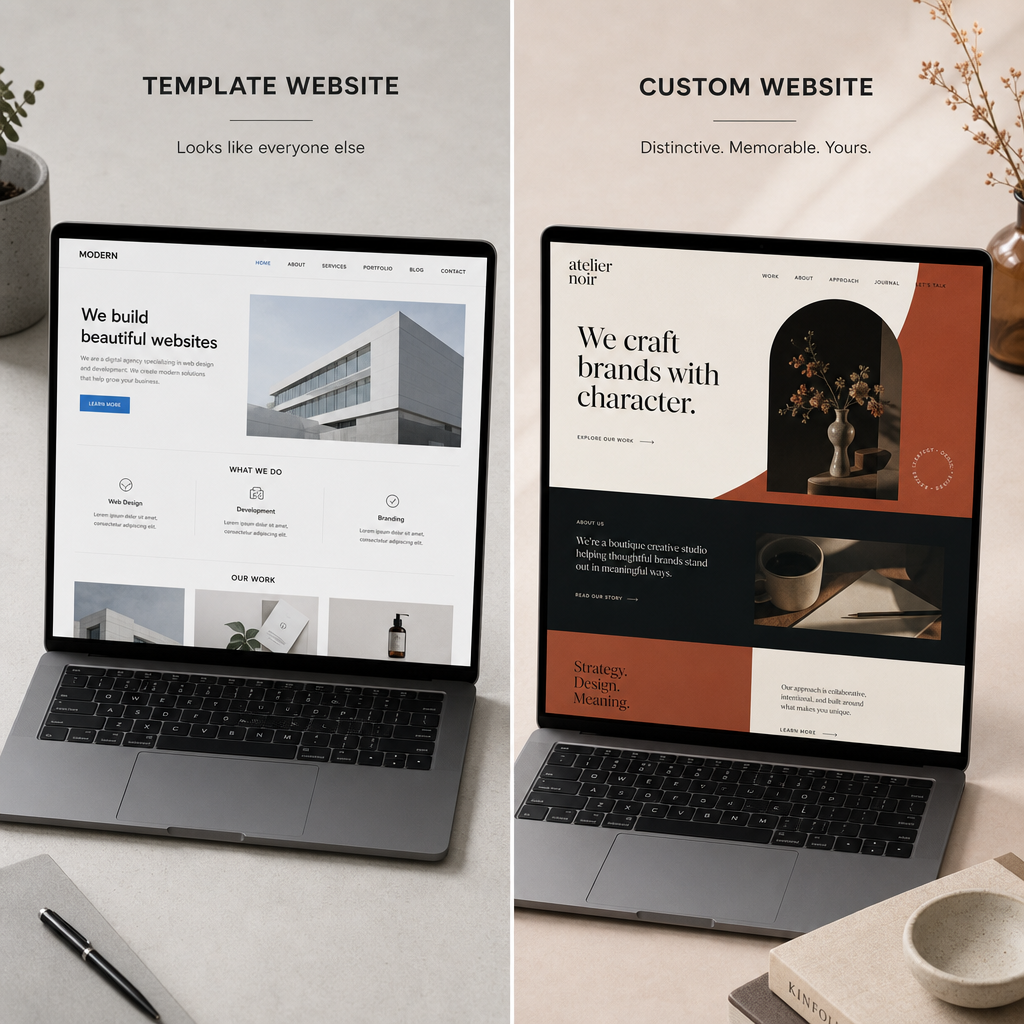
In practice, most Wix users pick one of the roughly 900 available templates and make surface-level edits: swap the logo, change the colors, update the text. The result is a site that looks like other Wix sites because, structurally, it is. Customers may not consciously recognize the template, but they do register that the experience feels familiar and unremarkable.
A common mistake is assuming that changing fonts and images is the same as custom design. It is not. Layout decisions, information hierarchy, and conversion flow require intentional design choices that templates cannot make for your specific business.
Platform Lock-In Is a Real Risk
Your Wix site lives on Wix servers and is built on Wix's proprietary system. If you decide to migrate to a more powerful platform later, you are not moving files. You are rebuilding. Every business that has outgrown Wix and needed to move has discovered this the hard way.
Pro tip: If you are evaluating Wix for your business, ask yourself what the site will need to do in three years. If the answer involves advanced ecommerce, custom integrations, or serious SEO performance, design to that goal from day one rather than paying to migrate later.
What Professional Web Design Actually Gives You
Professional web design is not about aesthetics for their own sake. Done correctly, it means your site is built around what your specific audience needs to see, in the order they need to see it, on a technical foundation that supports long-term growth.
At High Plains Webmaster, the approach treats a website as a 24/7 sales tool, not a digital brochure. That distinction matters enormously. A digital brochure presents information. A sales tool is engineered to move someone from awareness to inquiry to transaction.
Custom Architecture Serves Your Business Model
A professional build starts with questions about your customer, your margins, your conversion goals, and your competitive positioning. The site architecture flows from those answers. If your primary goal is lead generation, the site is built to prioritize contact form completion. If it is ecommerce, product discovery and checkout flow get the engineering attention they deserve.
This is the difference between a site that exists and a site that performs. The data consistently shows that businesses investing in professionally designed, strategically built websites see measurably higher conversion rates than businesses on template platforms.
Ownership and Portability
A site built on WordPress, a headless CMS, or a properly configured open platform is yours. You can move hosts, swap agencies, hire internal developers, or sell the business with the digital asset intact. That flexibility has real monetary value that is easy to overlook when comparing upfront costs.
"48% of people cited a website's design as the number one factor in deciding the credibility of a business." HubSpot, Marketing Statistics Report
SEO: The Gap Nobody Talks About
This is where the Wix versus professional design comparison gets genuinely consequential for small business owners. SEO is not just a feature you toggle on. It is determined largely by how your site is built at a technical level.
Wix has improved its SEO capabilities significantly over the past few years, and credit is due for that. But there remains a meaningful performance gap when compared to sites built with SEO-first architecture. Core Web Vitals, the set of performance metrics Google uses as ranking signals, consistently show Wix sites performing below optimized custom builds on metrics like Largest Contentful Paint and Total Blocking Time.
Crawl Architecture and Indexation
Professional web design includes intentional decisions about site structure, internal linking, URL architecture, and schema markup. These decisions tell search engines what your site is about and which pages deserve priority. Wix generates these structures automatically, which means they are optimized for Wix's system, not for your specific keyword targets or competitive landscape.
According to Moz, technical SEO issues like poor crawl efficiency and JavaScript rendering problems are among the most common causes of organic ranking underperformance. These are precisely the categories where template platforms consistently struggle.
Local SEO for Small Business Specifically
For small businesses competing in local markets, the SEO stakes are even higher. Local pack rankings, Google Business Profile integration, and locally optimized landing pages require precise technical and content execution. A professionally designed site built with local SEO embedded in the architecture will consistently outperform a Wix site with SEO tools bolted on after the fact.
Pro tip: When evaluating any web design partner, ask specifically how they handle schema markup, page speed optimization, and Core Web Vitals. Vague answers about "SEO-friendly design" are a red flag. You want specifics.
Total Cost of Ownership
The upfront cost comparison between Wix and professional web design is not the honest comparison. The honest comparison is total cost of ownership over three to five years, measured against the revenue each option generates.
Wix plans range from roughly $17 to $159 per month depending on features. That sounds affordable until you add in the cost of Wix's app marketplace add-ons (many of which require separate subscriptions), the time you or an employee spend managing platform limitations, and the eventual rebuild cost when you outgrow the platform.
Calculating the Real Return
Here is a straightforward way to think about it. If a professionally designed site converts visitors at 3% instead of 1.5% (a realistic improvement supported by industry data), and your site receives 1,000 visitors per month with an average customer value of $500, that difference represents 15 additional customers per month. That is $7,500 per month in additional revenue from the same traffic.
The upfront investment in professional web design pays for itself in a fraction of the time most business owners assume. The question is never really whether you can afford professional design. It is whether you can afford to keep leaving that revenue on the table.
Platform Comparison: Wix vs. GoDaddy vs. Professional Design
Factor | Wix / GoDaddy Website Builder | Professional Web Design (High Plains Webmaster) |
|---|---|---|
Setup Speed | Fast (days to weeks) | Thorough (weeks to months, depending on scope) |
Design Uniqueness | Template-based, limited differentiation | Custom to your brand, audience, and goals |
SEO Performance | Basic tools, structural limitations | Built-in technical SEO architecture from day one |
Conversion Optimization | Generic layout, no strategic UX planning | Strategically designed to drive specific conversions |
Ownership | Platform-dependent, not portable | You own the site and all assets |
Scalability | Limited by platform infrastructure | Scalable with your business growth |
Ongoing Support | Self-managed or community forums | Dedicated agency partnership and technical support |
When Wix Is Actually Fine
Intellectual honesty requires saying this: Wix is genuinely appropriate for a specific subset of use cases. If you are a sole proprietor testing a new business idea and need a placeholder site before you validate market demand, Wix is a reasonable temporary solution. If you run a small local operation with a fixed customer base that does not rely on online discovery, a basic Wix site may be entirely sufficient.
The problem is that most small business owners are not in either of those situations. They are running businesses where the website is genuinely supposed to generate new customers, and they are using Wix because it felt easier, not because it was the right tool for that goal.
If your website is supposed to compete for search traffic, convert strangers into customers, and represent your brand to people who have never heard of you, Wix is not the right foundation. That is not a knock on Wix. It is a matter of using the right tool for the job.
What a Real Wix Alternative Looks Like
A credible Wix alternative for a growth-focused small business is not Weebly or GoDaddy's website builder. Those platforms have the same fundamental limitations with slightly different interfaces. A real alternative is professional web design delivered by a team that understands both the technical and commercial dimensions of what a website needs to do.
The best small business website design outcomes come from agencies that treat your site as a business asset, not a creative project. That means starting with your customer, your competitive environment, and your revenue goals before touching a single design element.
What to Look for in a Web Design Partner
The right partner asks you about your customers before they show you a portfolio. They talk about conversion rates, not just aesthetics. They explain their technical approach to SEO in plain language. And they give you ownership of everything they build.
High Plains Webmaster's approach is built on exactly these principles. The sites we build are engineered to perform in competitive markets, not just to look good in a screenshot. That is the actual difference between a site that costs money and a site that makes money.
Frequently Asked Questions
Can a Wix site rank on the first page of Google?
Technically yes, but it is significantly harder to achieve and maintain compared to a professionally built site. Wix's JavaScript rendering, limited server-side optimization, and template-generated URL structures create obstacles that do not exist on custom-built sites. For highly competitive local or national markets, these limitations will show up in your rankings.
How much should a small business expect to invest in professional web design?
A professionally designed small business website typically ranges from $3,000 to $15,000 depending on complexity, number of pages, ecommerce requirements, and the level of SEO buildout included. That range sounds wide, but the variables are straightforward. The more important number is the revenue return, which in most cases justifies the investment within the first year.
What happens to my Wix site if I decide to switch to professional design?
Your content (text, images, branding) can be migrated, but the Wix site itself cannot be moved. A new site gets built from scratch on a portable platform. This is actually an advantage because the new build is designed properly from the start rather than being constrained by decisions made for a template platform.
Is WordPress a good Wix alternative for small businesses?
WordPress is the most widely used content management system in the world for good reason. It offers complete design flexibility, strong SEO capability, and full ownership of your site. However, WordPress requires professional configuration and ongoing maintenance to perform well. A self-managed WordPress site without technical expertise can be just as problematic as Wix. The platform is only as good as how it is implemented.
How long does it take to see results from a professionally designed website?
For SEO-driven traffic, expect a three to six month ramp as Google indexes and evaluates the new site. For conversion improvements visible to existing traffic, changes can be measurable within the first month. Businesses migrating from Wix to a professionally built site typically see meaningful traffic and lead generation improvements within the first two quarters.
Do I need a web designer if my business is purely local with walk-in customers?
Even primarily walk-in businesses now depend on online search for new customer discovery. Google searches for local businesses with "near me" intent have grown consistently year over year. A professionally optimized local website directly influences how often your business appears in those searches and how credible it looks to someone deciding whether to visit. The stakes are lower than for an ecommerce business, but they are not zero.
Have you been through the experience of moving from a template platform to a professionally built website? Share what surprised you most about the difference.